
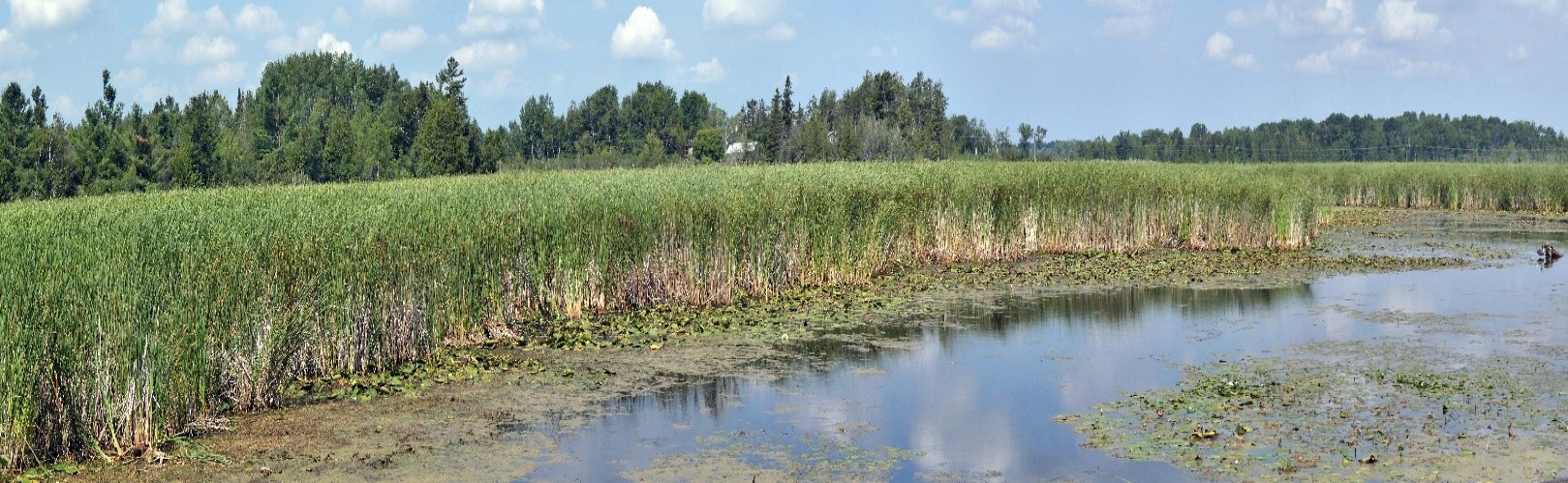
Cattail Panorama (Photo: John F. Foster)
In This Issue:
- Upcoming South Shore Events
- Isn't weather strange? Dew helps mustards bloom
- Shadow River
- Quotes
- Naked Eye Astronomy - April 2026 and May 2026
- For The Rose Breasted Grosbeaks
- County did you know...riddles
- Word Searches
- Kids Korner - Sit Spots in Nature (pdf)
- Kids Korner - Simple Sit-Upons (pdf)
- Pathways of Spread (pdf)
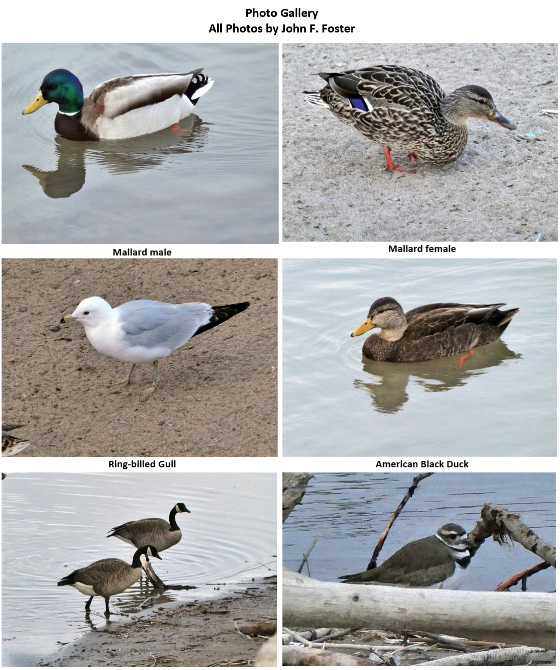
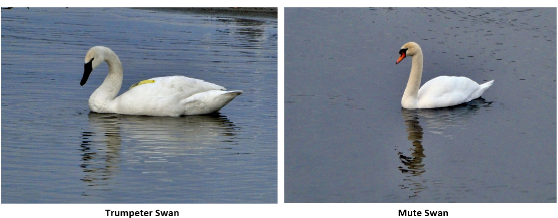
- Photo Gallery
Upcoming South Shore Events
Discover the ephemeral flowers of Spring in Point Petre Woods on a Wildflower Walk with John Lowry.
Meet at the corner of Cty. Rd. 24 and Army Reserve Road on Sat., May 9 2026 from 9:00 A.M. to 12:00 Noon. RSVP.
Join members of the Royal Astronomical Society of Canada to Explore the Stars with Your Library Card.
A Seestar S50 smart telescope may be borrowed with your Library Card.
The Astro Talk will be at Picton Library, Flex Space on the lower level, 208 Main Street, Picton, ON K0K 2T0 from 2:00 to 3:00 P.M. on Sat., May 9, 2026. To learn more about the Astro Talk, go here .
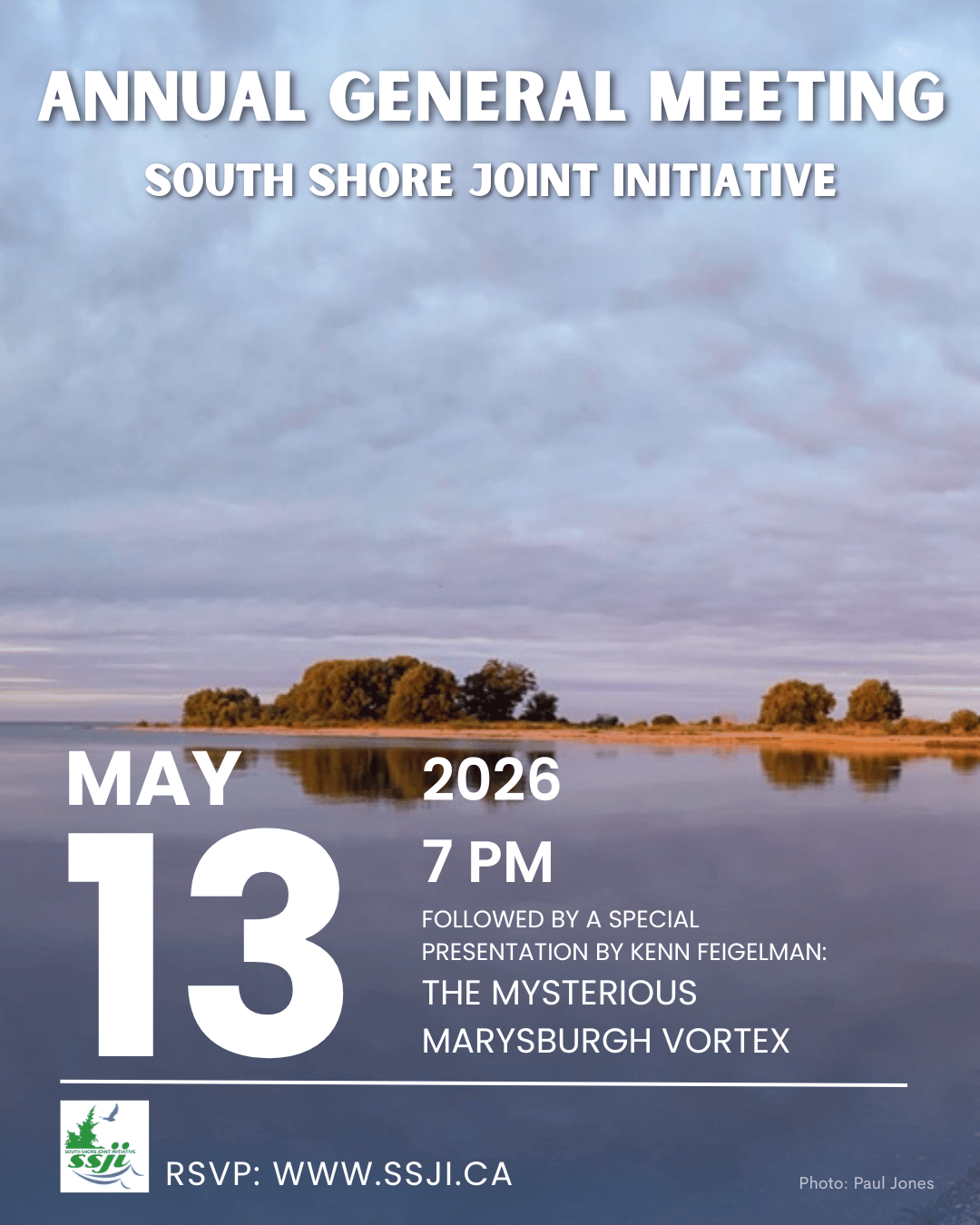
Join us for SSJI’s 2026 Annual General Meeting (AGM) via ZOOM on Wed., May 13, 2026 from 7:00 to 8:30 P.M.
The AGM will be followed by a special guest presentation on The Legendary Marysburgh Vortex by Ken M. Feiglman. RSVP.

Space is limited! RSVP for South Shore Events now at ssji.ca
Unable to attend and want to support? Donate or become a member now at ssji.ca
Isn't weather strange? Dew helps mustards bloom while lightning lights up leaf tips.
📝 Clement Kent1.2
A new study looked at what helps trigger flowering in some plants in the cabbage-kale family - the Brassicas. A number of these are early blooming annuals that flower in late spring or early summer, including the mouse-eared cress Arabidopsis thaliana. This cress is a favorite of botanists because a generation can be as short as six weeks, enabling quick experiments.
Some of the study authors were in the Netherlands, where this cress grows as a field weed. They noticed many of the plants in some places flowering together. They looked at the weather, but none of air temperature, sunshine, nor rain seemed to explain the synchronous blooming. Then they found that often the big blooms occurred about a week after nights when there were heavy dews. So off to the greenhouse they went.
Sure enough, manipulating both temperature and humidity in the greenhouse so there would be dew at dawn boosted flower bud formation. They traced the effect to tiny hairs on plant leaves and stems where dew droplets tended to form. A chemical reaction in these droplets helped produce nitric oxide which was absorbed by the plant and went on to damp down expression of genes that inhibit bud formation. Most of the study goes into how this all works.
But then they wondered: cress is in the Brassicas - could other species in the family have the same response? In the kind of tour-de-force that computers have made possible, they looked at a database of twelve million records of flowering in cabbage, kales, mustards, broccoli, etc. and compared them to weather records. Sure enough, they found that many species have a similar dewy-eyed response in triggering flowers.
So, the next time you see the early morning sun glittering on millions of dew droplets, think of how some plants may be sensing this and revving up their flowering engines.
So much for dawn. Let's look at weather that usually comes in afternoon or early evening - thunderstorms. We know that before lightning strikes, there can be large electric fields on the ground. We also know that electric fields get concentrated near sharp tips, from static sparking from our fingertips as we walk over dry winter wool rugs, or from the needle points in a showy Tesla spark generator.
So, some botanists wondered what the huge electric fields before a thunderstorm did to plants with pointy leaves. They had to invent instruments that could photograph tiny electrical discharges from leaf tips, then put them in a van that could be driven to a forest on days when thunderstorms were predicted, and try to catch the little sparks with their super cameras when the sky was dark.
Sure enough, trees with sharp-tipped leaves did have tiny coronal sparks even though they weren't hit by lightning. Infect, enough electricity passed through tips of some pine needles or sharply pointed sycamore leaves that the tissue at the tips was killed. This could be seen as teeny brown tips on leaves after a storm.
The authors note that climate change is predicted to bring us more dry lightning, and ask whether leaf tip browning will become an issue for some species of trees in the future.
References:
1 - Richter, Hanna. 2026. In a first, researchers film treetops glowing during thunderstorms in “Science”, American Association for the Advancement of Science (AAAS), Washington, D.C., USA. doi: 0.1126/science.zgdl9r1 and https://www.science.org/content/article/first-researchers-film-treetops-glowing-during-thunderstorms Accessed 20260409 Thurs.
2 - Zheng, Yu et al. 2026. Foliar dewdroplet–induced redox cascades promote early flowering in Brassicaceae plants. PNAS 123 (8): 1-7. National Academy of Sciences, Washington, D.C., USA. https://doi.org/10.1073/pnas.2527021123 and https://www.pnas.org/doi/epdf/10.1073/pnas.2527021123. Accessed 20260409Thurs.
Shadow River
📝 Emily Pauline Johnson (Tekahionwake)1
A STREAM of tender gladness,
Of filmy sun, and opal tinted skies;
Of warm midsummer air that lightly lies
In mystic rings,
Where softly swings
The music of a thousand wings
That almost tones to sadness.
Midway 'twixt earth and heaven,
A bubble in the pearly air, I seem
To float upon the sapphire floor, a dream
Of clouds of snow,
Above, below,
Drift with my drifting, dim and slow.
As twilight drifts to even.
The little fern-leaf, bending
Upon the brink, its green reflection greets,
And kisses soft the shadow that it meets
With touch so fine,
The border line
The keenest vision can't define;
So perfect is the blending.
The far, fir trees that cover
The brownish hills with needles green and gold,
The arching elms o'erhead, vinegrown and old,
Repictured are
Beneath me far,
Where not a ripple moves to mar
Shades underneath, or over.
Mine is the undertone;
The beauty, strength, and power of the land
Will never stir or bend at my command;
But all the shade
Is marred or made,
If I but dip my paddle blade;
And it is mine alone.
O! pathless world of seeming!
O! pathless life of mine whose deep ideal
Is more my own than ever was the real.
For others Fame
And Love's red flame,
And yellow gold: I only claim
The shadows and the dreaming.
1 - Johnson, Emily Pauline (Tekahionwake). 1922. Shadow River in “Flint and Feather - The Complete Poems of
E. Pauline Johnson, 8th ed.”, Pp. 46-47. The Musson Book Company Limited, Toronto.
Quotes
"An understanding of the natural world and what 's in it is a source of not only a great curiosity but great fulfillment." -- David Attenborough
“We cannot solve our problems with the same thinking we used when we created them.” -- Albert Einstein
County did you know … Invasive Shrub Riddles
📝 John F. Foster
1) I have square green stems. I have a fruit called an aril in 4-lobed capsules. I have crimson fall foliage.
Who am I? _________________________
2) I can have green or purple foliage. I have a small red berry. I have lots of small thorns.
Who am I? _________________________
3) I have a 5-petalled white flower. I have a fruit called a hip. I have curved spines on my stem.
Who am I? _________________________
4) I have small leaves with many teeth. I have a fruit called a samara. I grow as a small tree by streams.
Who am I? _________________________
5) I have single or 3-lobed leaves. I have a fruit called a syncarp. I grow wild or cultivated in many forms.
Who am I? _________________________
6) I have small leaves with a tip notch. I have a red globular berry. I have lots of orange berries in the fall.
Who am I? _________________________
(See Answers in The South Shoreliner – Vol.7 No.3 – June, 2026)
County did you know … Winter Related Riddles Answers
📝 John F. Foster
1) I am the colours of the rainbow. I shimmer like curtains. I am found mostly in the far north.
Who am I? Aurora Borealis
2) I am small and fluffy. I am always different. I am geometrical.
Who am I? Snowflake
3) I look like a kitchen utensil. I am in the northern sky. I am also likened to a bear.
Who am I? Big dipper
4) I form intricate patterns on glass. I am seen in late Autumn. I also am on grass in early cool spells.
Who am I? Frost
5) I am a weather event. I happen with rain and snow together. I am beautiful in sunlight.
Who am I? Ice Storm
6) I form when it is a little above freezing. I am a long cone shape. I am very shiny in sunlight.
Who am I? Icicle
(Appeared in The South Shoreliner – Vol.7 No.1 – February, 2026)
Word Searches
For The Rose Breasted Grosbeaks
📝 Molly Lawson1
Woods wildflower riot,
Trees budding with green --
The time is at hand:
Rosie friends will soon preen
In the branches, like ornaments,
Here and there flitting by,
On the feeders, at the window --
Symphony on the fly.
Oh, my friends, since a child
Wrote a piece praising you!
There’s old granddad, great granddad,
There the young, parent too.
Breasts bibs brightness and vigour
Shout out who is who
As they vie for the seeds --
Feeders full -- right on cue.
Early morning and evening
Rosies light in the tree --
Spring streams of brightness
Flash and cheer me!
If I’m tardy at filling,
A windowsill peer
Sends me running for seeds
To fill their feeder.
When they leave, it’s so lonely,
And I long for next year when
My Rosie friends return
Bringing blazing bright cheer.
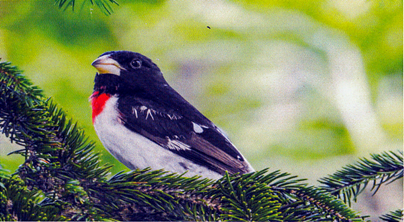
Rose-breasted Grosbeak (Photo with permission of Hélène Tremblay)
1 - Lawson, Molly. 2019. For the Rose-breasted Grosbeak in “For the Birds: A Prince Edward County Celebration”. Page 16.
Edited by J.C. Sulzenko. The Prince Edward Point Bird Observatory, Prince Edward Point, Ontario. Poem used with the permission of the author.
Photo Gallery
Do you like this page?
