

"Never doubt that a small group of thoughtful committed individuals can change the world. In fact, it's the only thing that ever has." -- Margaret Mead
In this Issue:
- Upcoming Events
- Eagles over The County by Paul Jones with illustrations by Sarah Sharp
- Summer Silence1 by Edwin E. Cummings
- The Bird’s Lullaby1 by Emily Pauline Johnson - Tekahionwake
- The Butterfly Effect by Jenn MacAusland
- Naked Eye Astronomy – August 2025 & September 2025 by Steve Burr
- Kids Korner by Cheryl Chapman:
- County did you know ... Terms for Young Birds Riddles by John F. Foster
- Photo Gallery by John F. Foster
- Word Searches by John F. Foster (incl. answers to word searches from the June issue of The South Shoreliner)
- Editor's Note
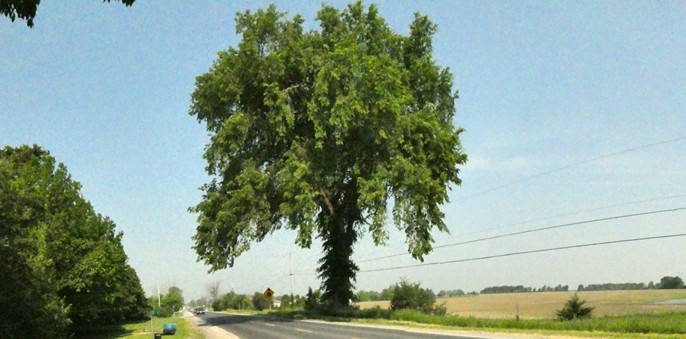
Panorama of PEC Landmark White Elm on Road 1 east of Hwy. 62 near Bloomfield (Photo: John F. Foster)
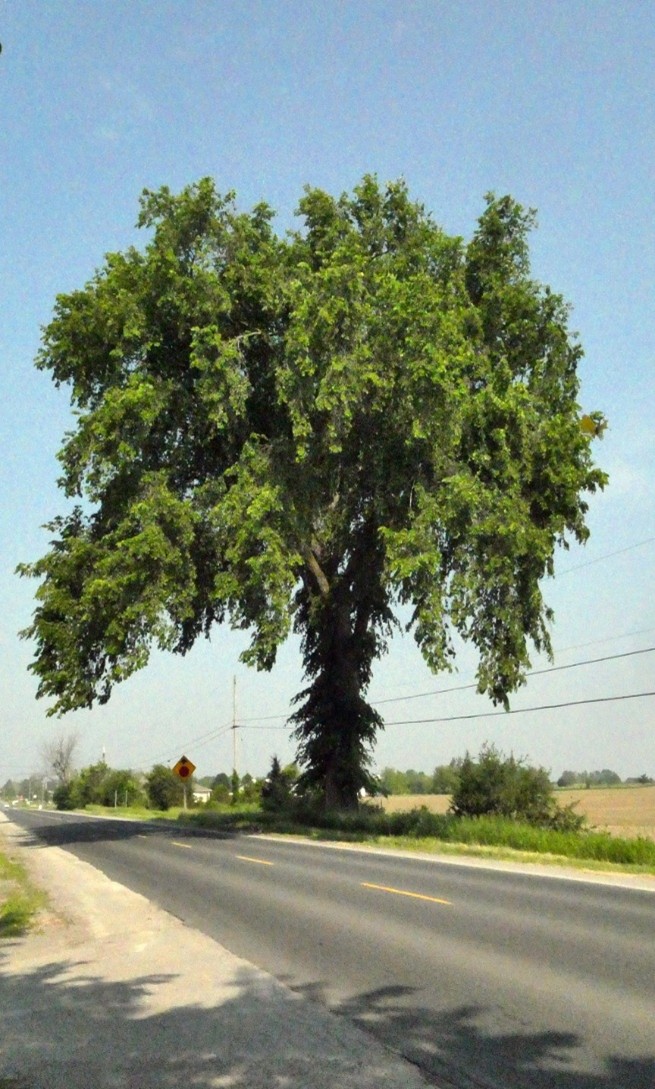
PEC Landmark White Elm - Ulmus americana (Photo: John F. Foster)
Upcoming Events
Be entertained at SSJI’s FREE Jazz, Wine & Art event on Sat., Aug. 16, 2025 from 1:00 to 4:00 PM.
- Meet at the Mount Tabor Shed, 2179 County Road 17, Milford.
- Enjoy vintage wine from Exultet Estates. Thrill to the sound of Jazz played by the Paco Liviano Quartet from 2:00 to 4:00 PM.
- Participate in the Silent Auction of local artists’ bird feeders - all handmade by Dick Bird.
- RSVP. For more information, contact Cheryl Anderson here.
See us at the Milford Fair event on Sat., Sept. 13, 2025 from 8:00 AM to 8:00 PM.
- Meet at the Milford Fair Grounds (Mount Tabor), 2179 County Road 17, Milford.
- Discover the rich biodiversity and cultural heritage of Prince Edward County’s South Shore and get the inside scoop on the exciting South Shore Footpath Project.
- Join us for a surprise Wild Thing activity - fun for all ages! SSJI at Milford Fair.
Interested in Astronomy? Come to the Milford Fair event on Sat., Sept. 13, 2025 from 9:00 AM to 8:00 PM.
- Meet at the Milford Fair Grounds (Mount Tabor), 2179 County Road 17, Milford.
- Talk to members of the Royal Astronomical Society of Canada (RASC) Belleville Chapter at their booth to learn about Dark Sky Project. RASC Belleville.
Save the date for SSJI’s Pints & Polka: Oktoberfest 2025 on Sat., Sept. 27, 2025 from 5:00 to 9:00 PM.
- Meet at the Mount Tabor Shed, 2179 County Road 17 in Milford.
- Proceeds from our major fundraiser of 2025 will directly fund our non-profit’s areas of action in PEC’s rare and fragile South Shore.
- RSVP. For more information, contact Cheryl Anderson here.

Eagles over The County
by Paul Jones with illustrations by Sarah Sharp
Eagles are magnificent birds, and Prince Edward County is fortunate to be blessed with two species, the Bald Eagle (Haliaeetus leucocephalus) and the Golden Eagle (Aquila chrysaetos).
Bald Eagle - Of the two, Bald Eagle is the most frequently seen. It is a year-round presence, with several pairs breeding locally and more arriving to overwinter. While easy to recognize in its black and white adult plumage, young birds are various shades of mottled brown and can be mistaken for Golden Eagle.
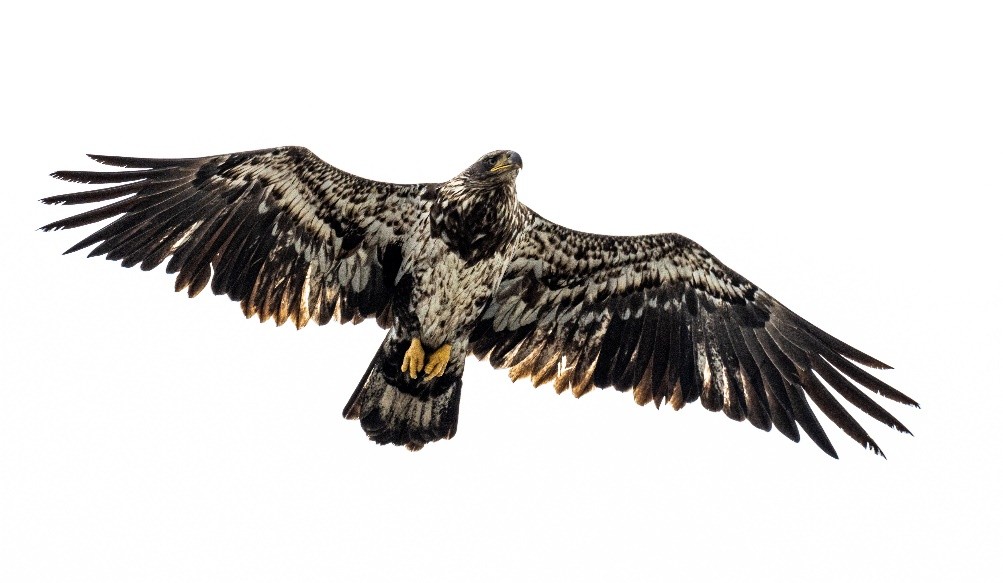
Bald Eagle young bird (Photo: Paul Jones)
Historically, Bald Eagles were common on Lake Ontario, but by the 1970s the southern Ontario population was almost wiped out. They were shot by gunners, displaced by shoreline development, and finished off by pesticides that accumulated in the food chain and destroyed their ability to reproduce.
Happily, the hard work of environmentalists brought about the protection of shoreline habitat, controls on the use of guns, and the banning of the deadliest pesticides. Bald Eagles have bounced back, and the bird is no longer endangered in Ontario - a testament to power of engaged citizens. Vigilance is still required, however, as the traditional threats of habitat destruction and pollution remain, and a new danger - wind turbines - has arisen.
Bald Eagles can now be seen in The County throughout the year anywhere along the lakeshore where they scavenge dead fish and waterfowl. In the winter the Picton and Wellington harbours, and south shore headlands such as Point Petre and Prince Edward Point, are particularly good places to look. Watch for them perched in dead trees, sitting on the ice, or flying low overhead patrolling the shore.
Golden Eagle - In contrast to Bald Eagles, Golden Eagles have a more fleeting local presence. They only pass through briefly in the late fall on the way south from their northern breeding grounds. As with Bald Eagle, they endured a steep population decline over the last century, with organized shooting and poisoning campaigns taking a terrible toll. The worst of this behaviour has been curtailed and their population has stabilized, although they remain classified as endangered in Ontario.
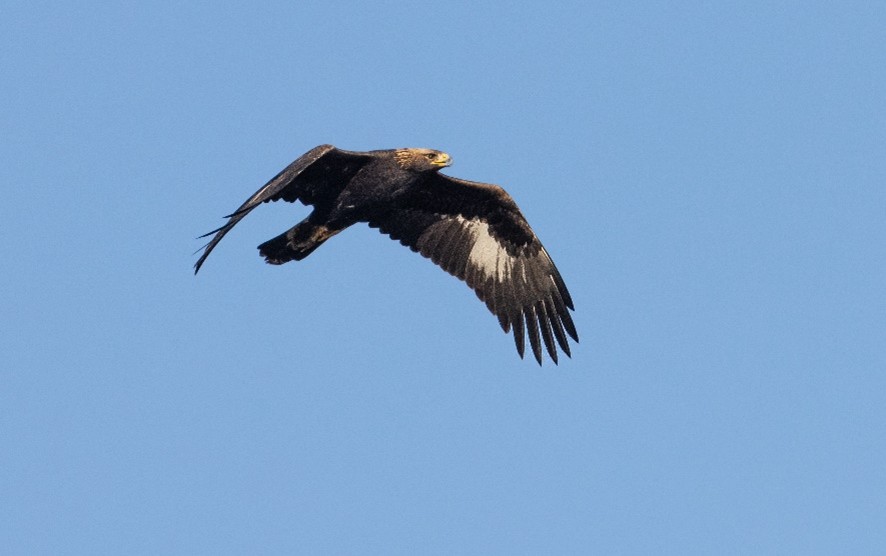
Golden Eagle young bird (Photo: Paul Jones)
Unlike most north-south migrants, Golden Eagles appear here almost exclusively in the fall, and not in the spring. Moreover, the birds that do pass through are mostly juveniles. These peculiarities can be explained by The County’s geography, and the reluctance of this species to cross large bodies of water. In the spring, northbound Golden Eagles reach the New York shore of Lake Ontario and head east towards Kingston and then north, rather than risking the deep-water crossing. In the fall, young birds on their first southward migration follow the north side of Lake Ontario to PEC’s protruding south shore. With no easy way across the water, they circle about, reorient themselves, and head back inland east towards Kingston or west towards Hamilton to continue their journey. This lesson in geography apparently sticks, as very few adult birds repeat the mistake and venture into The County.
With respect to seeing one, it takes more of an effort to spot a Golden Eagle than a Bald Eagle. Their presence is restricted to a narrow period in the late fall, and they are typically moving high and fast, rarely seen perching or hugging the water’s edge. The best bet for a sighting is a hike at Point Petre or the Prince Edward Point National Wildlife Area on a blustery late October or early November day. With luck, you might catch sight of one circling overhead or sweeping past against a grey sky, a true wilderness symbol.
Identifying Bald and Golden Eagles
With Golden Eagles under threat, citizen scientists have an important role to play in documenting their passage through The County. Caution is required, however, as in their immature plumages both Golden and Bald Eagles present at a glance as fairly similar huge brown birds. Not everyone is aware that Bald Eagles take several years to transform from dingy brown youngsters to black and white adults, resulting in a misapprehension that any brown eagle is a Golden Eagle.
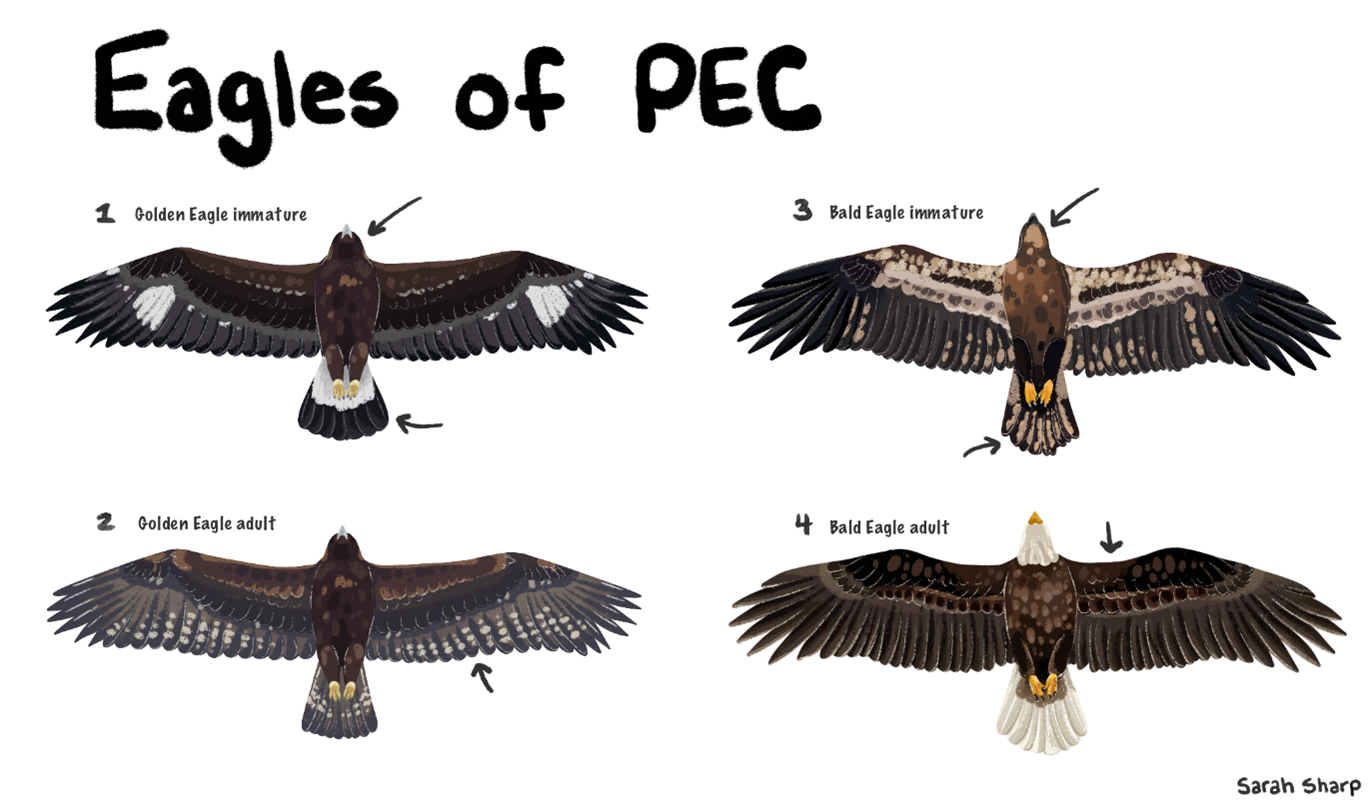
Eagle Field Guide Plate (Illustration: Sarah Sharp)
To avoid this mistake, first check your calendar. If it’s spring, summer, or winter your eagle is overwhelmingly likely to be a Bald Eagle. If it’s late October to mid-November, then Golden Eagle becomes a distinct possibility. Next, consider the way the bird presents. While the two species are similar in size, Bald Eagles appear as lumbering, large-billed, and flat-winged, whereas Golden Eagles are agile, smaller-billed and hold their wings in a slight V (in the manner of a Turkey Vulture). Next, what is the bird doing? If it’s perched in a tree or on the ground, or low along the shore, that points to a fish-scavenging Bald Eagle. If it's moving resolutely overhead, then maybe it could be Golden. The clincher comes with a decent look at the underside of the bird in flight. Young brown Bald Eagles typically are splattered with white all across the underwings and body, whereas on young Golden Eagles the white is restricted to distinct discrete white dots at the base of the flight feathers and the tail, and not throughout the wings and body. While this may sound like a fairly obscure difference, it is actually quite obvious with a decent view through binoculars.
Last Words - Prince Edward County is still eagle country. Keeping it this way will require continued work, as old threats may return and new ones arise. The whirling blades of wind turbines have killed eagles elsewhere, and present a particular danger for young Golden Eagles learning the way on their first journey south. So, watch the skies, record eagles, keep fighting to keep the land, air and water safe.
Summer Silence1
by Edwin E. Cummings
Eruptive lightnings flutter to and fro
Above the heights of immemorial hills;
Thirst-stricken air, dumb-throated, in its woe
Limply down-sagging, its limp body spills
Upon the earth. A panting silence fills
The empty vault of Night with shimmering bars
Of sullen silver, where the lake distils
Its misered bounty. — Hark! No whisper mars
The utter silence of the untranslated stars.
1 - Cummings, Edwin E. 1913. Summer Silence. The Harvard Advocate Vol.95 in “Poets.org”.
https://poets.org/poem/summer-silence . Accessed Fri., Aug. 08, 2025.
The Bird’s Lullaby1 by Emily Pauline Johnson - Tekahionwake
I
Sing to us, cedars; the twilight is creeping
With shadowy garments, the wilderness through;
All day we have carolled, and now would be sleeping,
So echo the anthems we warbled to you;
While we swing, swing,
And your branches sing,
And we drowse to your dreamy whispering.
II
Sing to us, cedars; the night-wind is sighing,
Is wooing, is pleading, to hear you reply;
And here in your arms we are restfully lying,
And longing to dream to your soft lullaby;
II
While we swing, swing,
And your branches sing,
And we drowse to your dreamy whispering.
III
Sing to us, cedars; your voice is so lowly,
Your breathing so fragrant, your branches so strong;
Our little nest-cradles are swaying so slowly,
While zephyrs are breathing their slumberous song.
And we swing, swing,
While your branches sing,
And we drowse to your dreamy whispering.
1 - Johnson, Emily Pauline - Tekahionwake. 1922. “The Bird’s Lullaby” in Flint and Feather, 8th ed., P.51. The Musson Book Company Ltd., Toronto, ON. https://allpoetry.com/The-Birds'-Lullaby - Accessed Mon., May 26, 2025.
County did you know … Terms for Young Birds Riddles
by John F. Foster
1) I start life in an egg. I peck my way out of the egg with a special tooth. I am wet once out.
Who am I? _________________________
2) I live in a round structure called a nest. I rest on mostly plant material. I am warmed by my mother.
Who am I? _________________________
3) I practise flapping my wings. I often stand on the rim of the nest. I leave the nest when I am ready.
Who am I? _________________________
4) I sometimes still have down. I am still fed by my parents after leaving. I am still a bit small.
Who am I? _________________________
5) I fly but only weakly. I have lost my down. I have started some feeding of myself.
Who am I? _________________________
6) I am the same size as an adult. I have different colouration than adults. I can feed myself.
Who am I? _________________________
(See Answers in The South Shoreliner – Vol.6 No.5 – October, 2025)
County did you know … Water Riddles Answers
by John F. Foster
1) I am water left over after a rain. I drain into the ground. I go to the nearest stream.
Who am I? Runoff
2) I am found in the forest after winter. I have no outlet. I contain no fish.
Who am I? Vernal Pool
3) I am a small stream found in forests. I sometimes make babbling noises. I have cold water.
Who am I? Brook
4) I am a small open water body. I am not deep. I am often found on farms or in subdivisions.
Who am I? Pond
5) I form in the early morning when it is cool. I cling to surfaces. I am a signal for a warm day.
Who am I? Dew
6) I am often seen in valleys above trees. I am gossamer white. I am cool if you walk through me.
Who am I? Mist
(Appeared in The South Shoreliner – Vol.6 No.3 – June, 2025)
Editor's Note
This is the 31st edition of The South Shoreliner. The editor would like to thank the following for contributing to this 31st edition of The South Shoreliner: Margaret Mead, Paul Jones, Edwin E. Cummings, Jenn McAusland, Steve Burr, John F. Foster, Xiuhtezcatl Martinez, Emily Pauline Johnson - Tekahionwake, and Cheryl Chapman. Contributions make the newsletter readable and interesting. For the next and upcoming newsletters, contributions of articles, photos and events are always welcome.
-- John F. Foster, The South Shoreliner Editor
Do you like this page?