
📝 Steven Burr
The Moon
August begins with a first quarter moon on the 1st of the month followed by the Full Sturgeon Moon on the 9th. According to the Farmer’s Almanac, the name owes its origins to the giant lake Sturgeon which were harvested during this part of the summer. The last quarter moon arrives on 16th as it passes within one degree of the star cluster Pleiades. Early in the morning on the 19th, the waning crescent moon, Jupiter and Venus will all line up prior to sunrise in the east. On the 23rd we have a new moon followed by a first quarter on the 31st.
The Planets
Venus is still distancing itself from earth but remains visible near the eastern horizon just before sunrise. On the 12th, Venus and Jupiter will appear to almost touch just prior to sunrise. Mars remains in the constellation of Virgo low on the western horizon prior to sunset. On the 26th of the month, Mars and the waxing crescent moon pass within 3° of each other shortly after sunset. Jupiter is now a morning planet visible prior to sunrise in the constellation of Gemini where it will remain for most of the month. Saturn is now an evening planet rising just after 11 pm.
Perseid Meteor Shower
The Perseid meteor shower peaks during the evening of the 12th and the early morning hours of the 13th. Unfortunately, we have a waning gibbous moon rising at 9:53 pm reducing meteor visibility. The Perseid meteor shower appears to originate from the constellation Perseus and owes it origins to debris from the comet Swift-Tuttle, discovered by Lewis Swift and Horace Tuttle, in 1862. To observe this event, remove yourself from as much light pollution as possible and look to the NE for the constellation Perseus. You will need to give your eyes some time to adjust to the darkness. The best time for viewing is after midnight.
The Summer Triangle
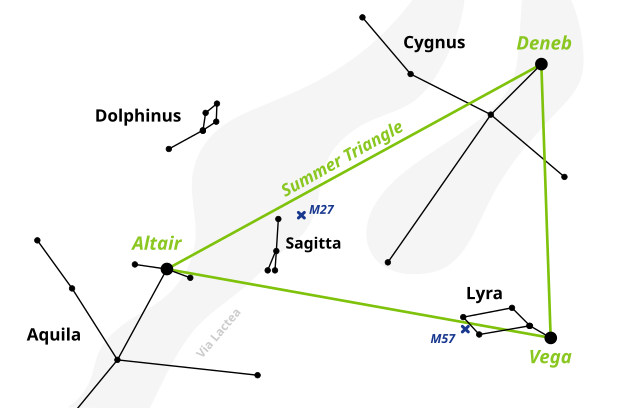
📸 Triangle d'ete Carte du ciel [1]
The summer triangle is an easily recognizable asterism in the summer sky. However this asterism is comprised of bright stars from three constellations: Cygnus (Swan), Lyra (Lyre) and Aquila (Eagle). The three stars that comprise the triangle are Deneb, Vega and Altair. Look overhead after sunset to see this asterism. According to Greek mythology, Zeus took the form of the swan in his efforts to seduce Nemesis, and the lyre was created by Hermes who hollowed out a tortoise shell to make the instrument. With regards to Aquila, it is the eagle that carried Ganymedes up to Zeus so the he may have a cup bearer, or Hermes being captivated by Aphrodite, Zeus sent the eagle to snatch her slipper and bring it to Hermes so they could meet.
References (for the August and September Blog posts):
Boeckmann, Catherine, Full Moon Names 2025 [online]. Almanac, updated January 2025 [cited 3 January 2025]. Available from: https://www.almanac.com/full-moon-names
Burnham, Robert, Burnham’s Celestial Handbook Vol 3 (New York: Dover Publications, 1978)
Edgar, James S. ed., RASC Observer’s Handbook 2025, ed. by James S. Edgar (Marquis Book Printing, 2024)
Hard, Robin, Eratosthenes & Hyginus: Constellation Myths (Oxford: Oxford University Press, 2015)
Mortillaro, Nicole, RASC 2025 Night Sky Almanac (Richmond Hill: Firefly Books, 2024)
Perseid Meteor Shower 2025 [online], Timeanddate, [cited 21 January 2025]. Available from: https://www.timeanddate.com/astronomy/meteor-shower/perseid.html
[1] Triangle d'ete Carte du ciel [online]. Wikimediacommons, updated 22 Sep 2024 [cited 24 Jan 2025]. Available from: https://commons.wikimedia.org/wiki/File:Triangle_d%27ete_Carte_du_ciel.svg

White, Gavin, Babylonian Star-Lore: An Illustrated Guide to the Star-Lore & Constellations of Ancient Babylonia (London: Solaria Publications, 2014)
Do you like this page?