
In This Issue:
- Upcoming South Shore Events
- Osprey Platforms
- I Heard a Bird Sing by Oliver Herford
- Going Green but not Evergreen - Fighting Fires before they start by Clement Kent
- Who Has Seen the Wind? by Christina Rossetti
- Naked Eye Astronomy by Steve Burr – December 2025 - January 2025
- Obscure Winter Words Search by John F. Foster (incl. answers for Obscure Autumn Word Search)
- Waiting for Winter by J.C. Sulzenko
- County did you know … Winter Bird Riddles by John F. Foster (incl. Autumn Plant Riddles Answers)
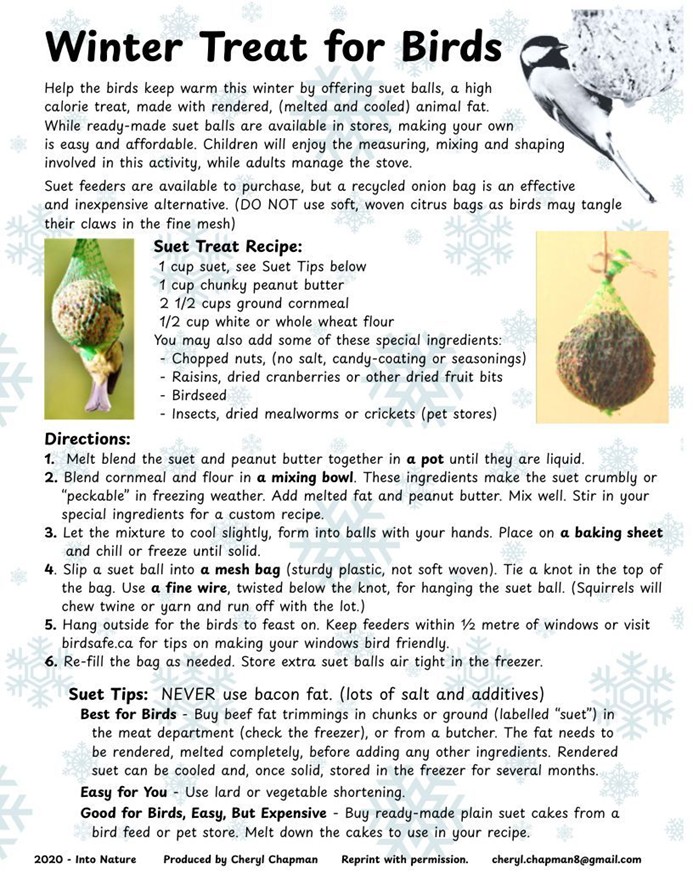
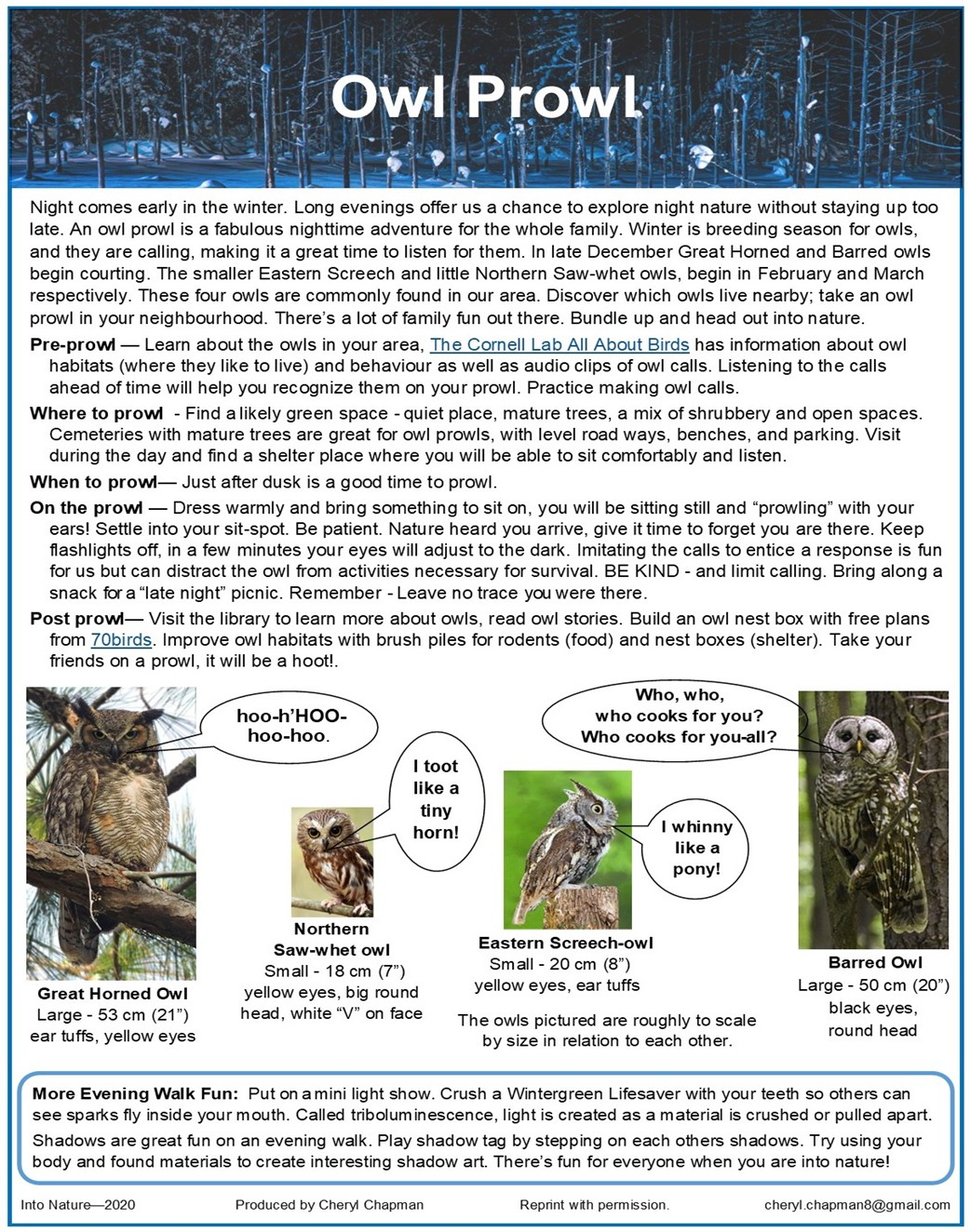
- Kids Korner by Chery Chapman: Winter Treat for Birds and Owl Prowl
- Celebration of Life for Myrna Wood by Cheryl Anderson
- Editor's Note
Upcoming South Shore Events
- Join members of the Royal Astronomical Society of Canada to learn about Astrophotography Through the Lense of Time (1840-2025). The Astro Talk will be at Picton Library, Flex Space on the lower level, 208 Main Street, Picton, ON K0K 2T0 from 2:00 to 3:00 PM on Sat., Jan. 10, 2026. To learn more about the Astro Talk, go here.
- Join members of the Royal Astronomical Society of Canada to learn how to use a Seestar S50 telescope. The telescope may be borrowed with your Library Card. The Astro Talk will be at Picton Library, Flex Space on the lower level, 208 Main Street, Picton, ON K0K 2T0 from 2:00 to 3:00 PM on Sat., Feb. 21, 2026. To learn more about the Astro Talk, go here.
- Our first-ever Square Foot Art Show + Sale will take place at Arts on Main Gallery on Main Street, Picton from January 23 to February 18, 2026. The Backroom gallery will showcase square foot artworks by local artists who are inspired by SSJI’s work to protect and preserve Prince Edward County’s South Shore. Event details available here.
Space is limited! RSVP for South Shore Events now at ssji.ca
Unable to attend and want to support? Donate or become a member now at ssji.ca
Osprey Platforms
by Cheryl Anderson
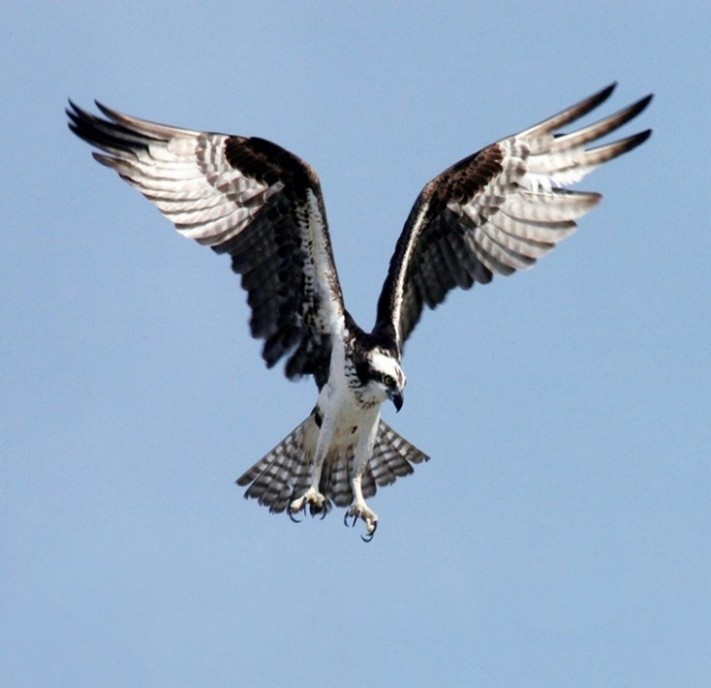
Flying Osprey hunting (Source: NASA KSC-04PD-1258)*
Thanks to donors to the Osprey Platform project, three new Osprey Platforms were erected on the South Shore in 2025. Also thanks to Dick Bird for building the platforms and Richard Copple for making the connection with Tagline Construction. Below are photos from the erection of the most recent platform.
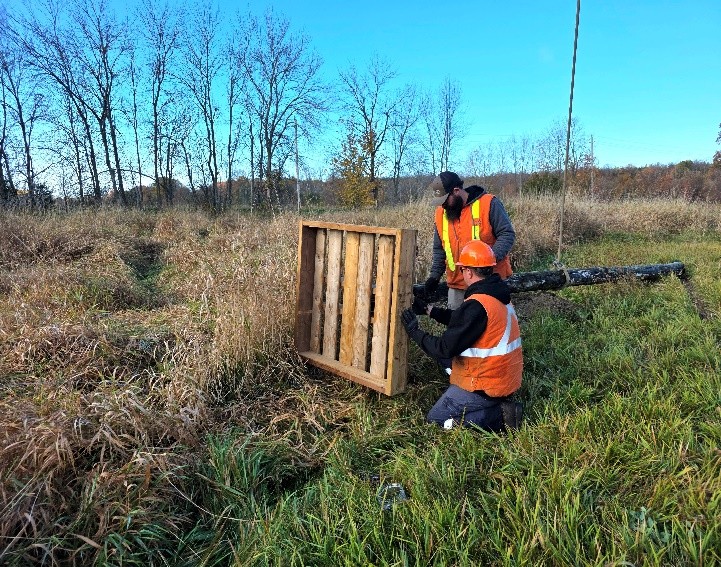
Readying Osprey platform base (Photo: Shawn Andrews)
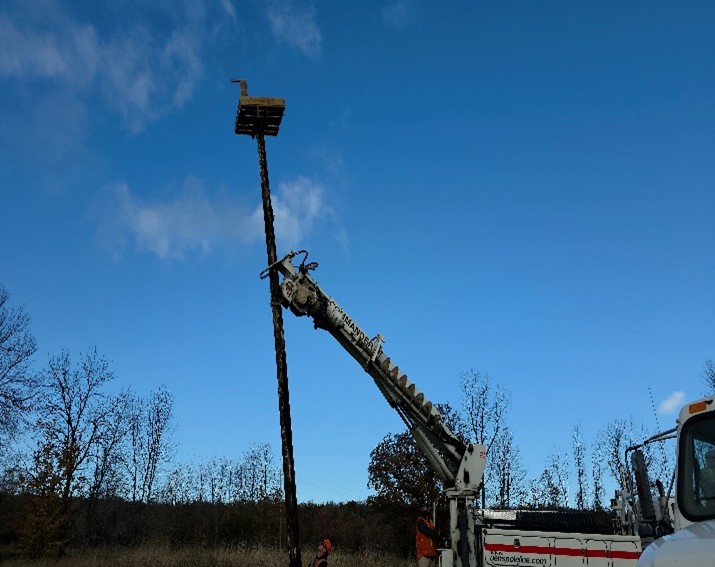
Erecting the Osprey platform (Photo: Shawn Andrews)
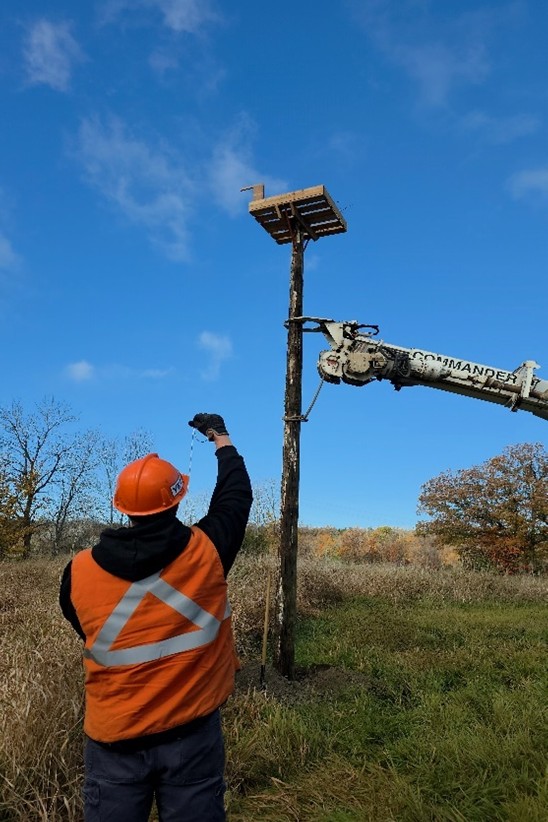
Steadying the Osprey platform (Photo: Shawn Andrews)
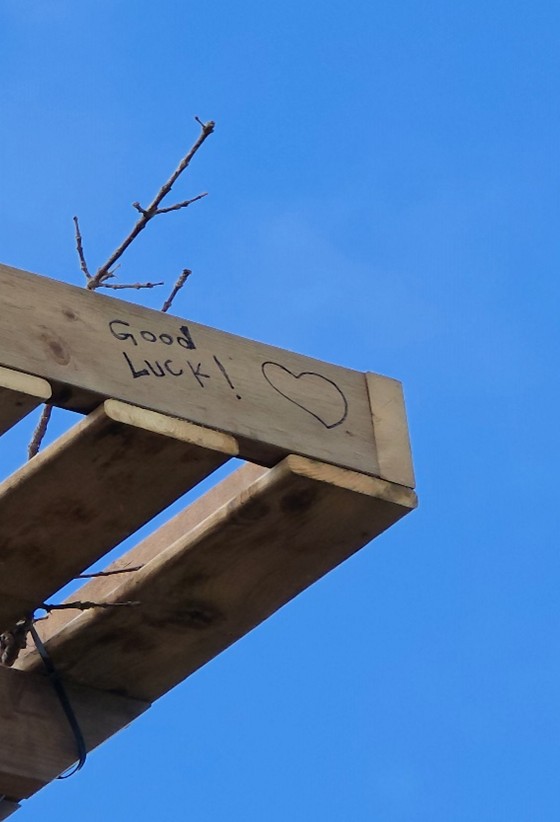
“Good Luck” to the Ospreys (Photo: Shawn Andrews)
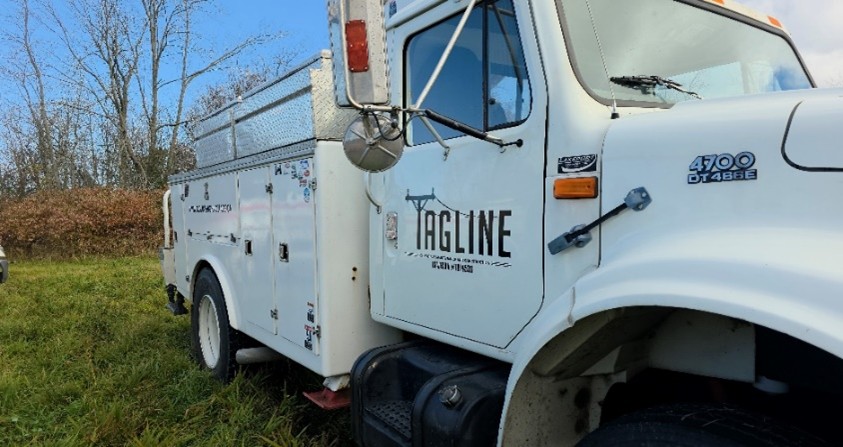
Tagline did the Osprey platform erecting (Photo: Shawn Andrews)
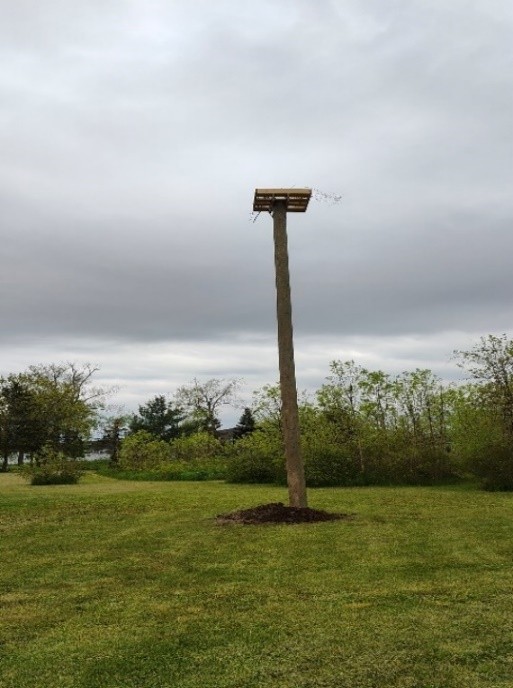
Assembled Osprey platform (Photo: Gurpreet Patheja)
* NASA. 2008. Osprey flying. Photo KSC-04PD-1258, NASA, Kennedy Space Center, Florida, USA
http://mediaarchive.ksc.nasa.gov/detail.cfm? Accessed 20251208Mon.
I Heard a Bird Sing1
by Oliver Herford
I heard a bird sing
In the dark of December.
A magical thing
And sweet to remember.
"We are nearer to Spring
Than we were in September,”
I heard a bird sing
In the dark of December.
1 - Herford, Oliver. 1955. I heard a Bird Sing. Poem in “Welcome Christmas! A Garland of Poems” compiled by Anne Thaxter Eaton. Viking Press, NYC, NY, USA. Pp.128. https://archive.org/details/welcomechristmas0000eato/mode/2up .
Accessed 20251208.
Going Green but not Evergreen - Fighting Fires before they start
📝 Clement Kent
The "Protecting Ontario from Urban Wildfires Act" introduced in the Ontario legislature marks an important step to raising the profile of urban wildfire risk awareness and action. We in conservation, landscaping, and gardening groups need to help our neighbours understand the risks and take the right protective steps. And, we’ll need to urge municipal and provincial lawmakers and civil servants to provide frameworks and revise rules to help us in this important climate mitigation task.
What’s the risk? Briefly, that in the next decade climate warming-driven wildfires like the ones that devastated parts of Jasper, Fort McMurray, Lytton, and many other towns will burn further south during droughts and heat waves.
I'm an adjunct professor in Biology at York. I speak often with gardening and landscaping groups. For the last few years, I’ve been warning these audiences that we need to adopt best in class practices for fire risk reduction. Of course, many of these practices are building-related and involve improving fences, siding, roofing, and eaves. But reducing the frequent use of higher flammability evergreens and other foundation plantings must be on our list.
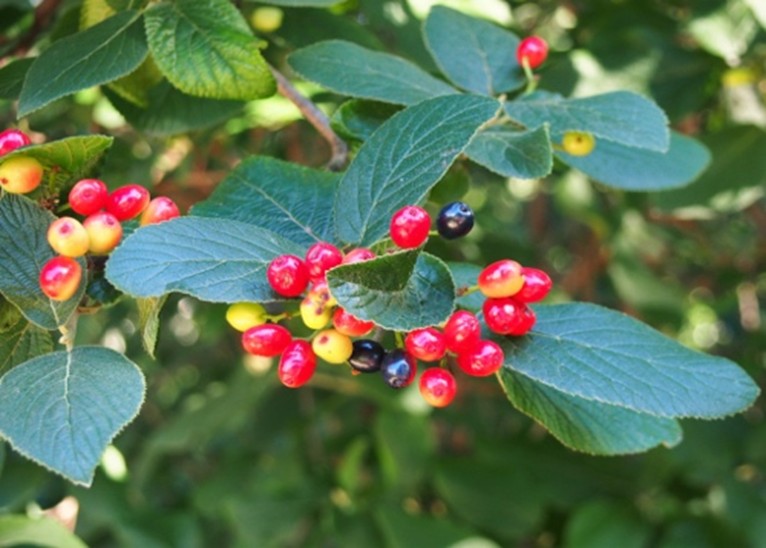
Nannyberry (Photo: Agnieszka Kwiecień 2020. CC ASA 4.0)
Evergreen conifers and tall grasses are commonly used near homes. Ontario does have a page on "FireSmart landscaping" but many (most) groups I speak to aren't aware of the facts it lays out. The Ontario page has a good list of native plants that can be used closer to homes – none are evergreen. Good shrubs include Nannyberry (Viburnum lentago) and Ninebark (Physocarpus opulifolius).
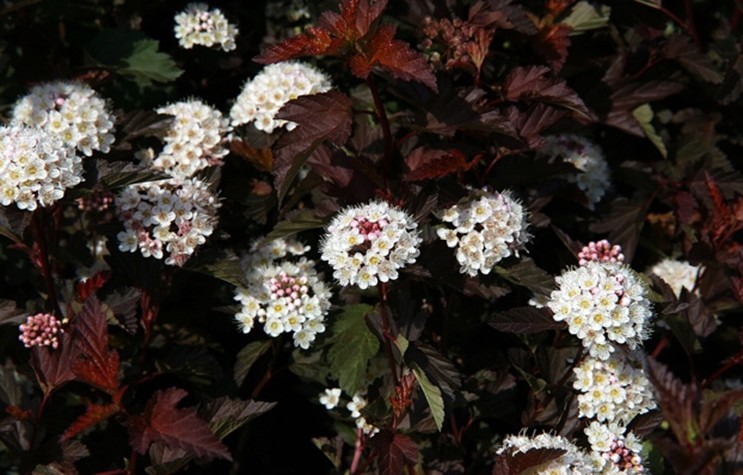
Ninebark (Photo: David Stang 2007. CC ASA 4.0)
FireSmart suggests ground covers like Wintergreen and Bearberry could be used between shrubs.
Native grasses are elegant additions to landscaping, but need to be kept away from your house. The worst-case scenario is a moist spring with luxuriant growth followed by dry and fall summer days. That’s what happened in the scrublands around “Marshall Colorado in 2021”. A high-speed wind system fanned an incredibly fast-moving grass fire front towards a subdivision. 37,500 residents evacuated; 8 had burns and 2 died. 1,084 buildings burned with estimated damage at US$2 billion.
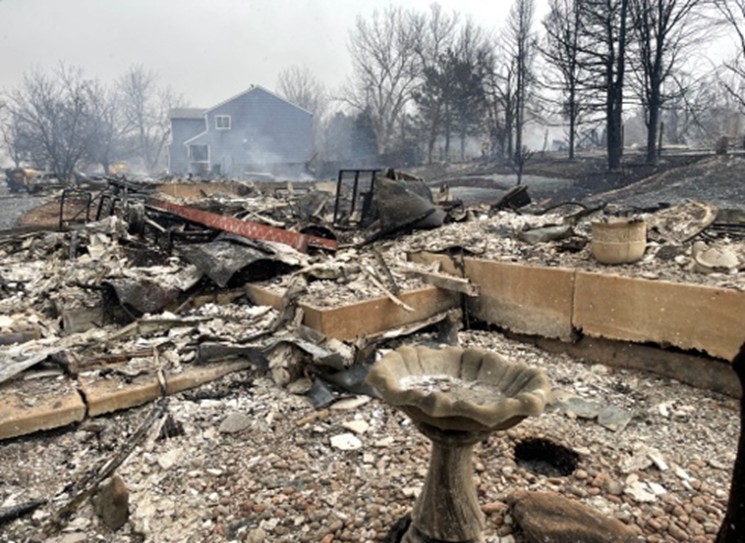
Marshall fire (Photo: BMurphy380., CC ASA 4.0)
The FireSmart concept of the "Home Ignition Zone" (HIZ) is the "100-200 feet around the home". Typically, this would include several properties in many of Ontario's downtown areas. My downtown lot is considered wide at 30 feet; defining an HIZ for my property would mean including 2 or 3 adjoining houses on each side. Several of them have large conifers right next to the house!
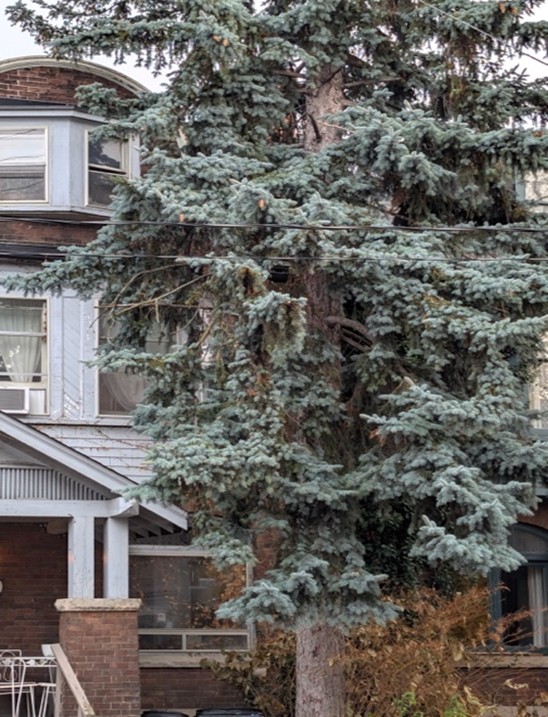
Blue Spruce across the street from my house (Photo: C. Kent. CC by SA 4.0)
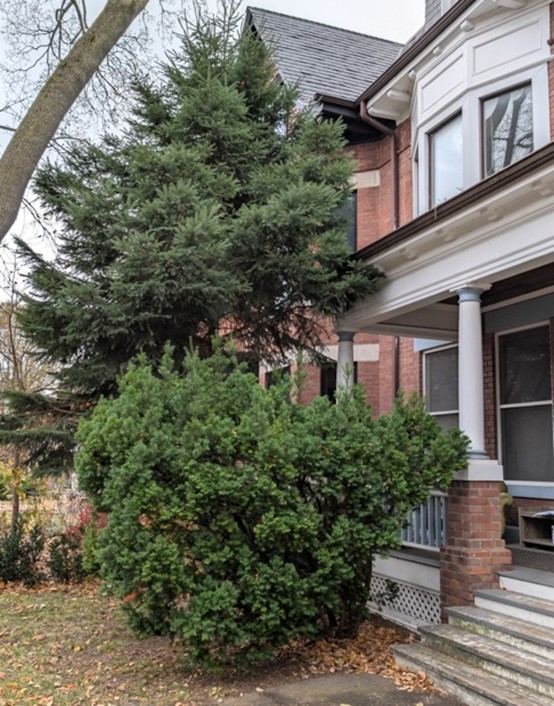
Spruce and Juniper lean on my neighbours' wood front porch (Photo: C. Kent. CC by SA 4.0)
Action at the provincial and municipal levels will be needed to remedy this. Toronto, for example, has many blue spruces or cedars that were planted as "nice" 4-5foot trees in yards. They have since grown to 3 or 4 stories tall and brush against the house. Yet to cut down one of these trees requires a costly permit from the city. A paper on Toronto's tree inventory said eastern white cedar is one of our most common trees. The Kamloops Fire Dept’s FireSmart website says “Cedar Hedges Are Flammable. High Resin Content: Cedars contain natural oils and resins…which are highly combustible. Fine, Dense Foliage: The compact structure and abundance of fine twigs and leaves can ignite easily and allow flames to spread quickly. Dry Material Accumulation: Dead needles and branches often collect within the hedge, acting as dry kindling. Low Moisture Retention: During hot, dry weather, cedars lose moisture and become even more prone to ignition.”
I’m conflicted on this. Many of our birds love dense evergreens as safe places to nest. But I suggest we start a 10-year program of removing flammable landscaping near our homes and replacing with less flammable native shrubs. We should also help our nurseries and landscapers build up lists and inventories of low flammability natives.
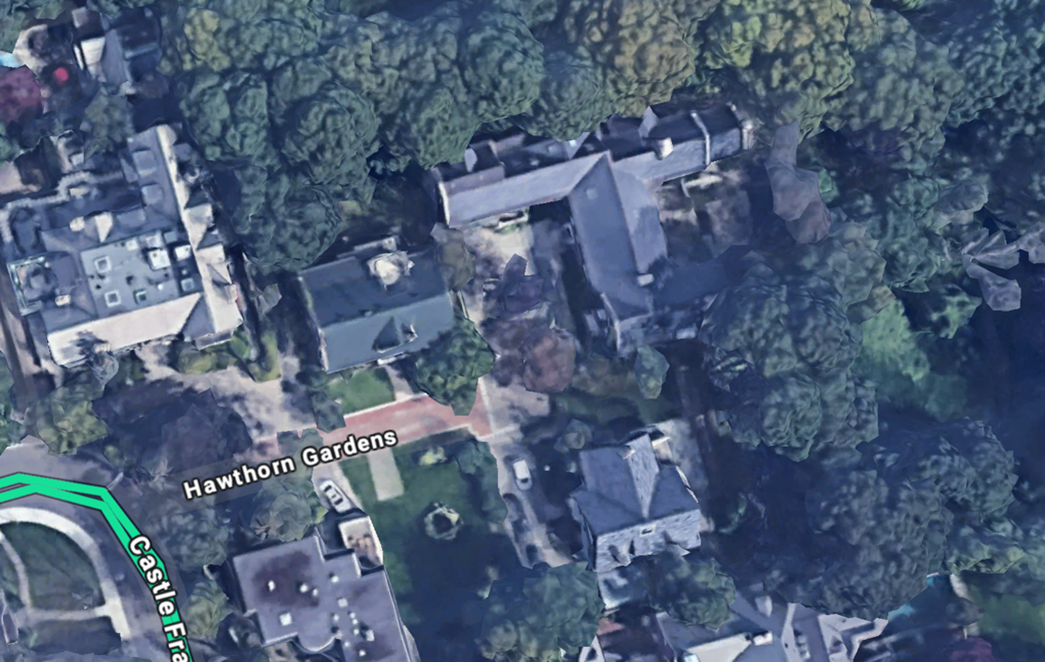
Rosedale mansions (Source: Google Maps)
Money talks. The politicians and others on this email should be aware that many of the most expensive properties in Toronto are adjacent to ravines and thus at higher risk, because fire spreads rapidly uphill. Those property owners could be a force in moving action forward if they were aware of the risks.
Please raise awareness of this bill, of the FireSmart information, and of the need for landscapers and homeowners to change planting practices.
Who Has Seen the Wind?1
Christina Rossetti
Who has seen the wind?
Neither I nor you:
But when the leaves hang trembling,
The wind is passing through.
Who has seen the wind?
Neither you nor I:
But when the trees bow down their heads,
The wind is passing by.
1 - Rossetti, Christina. 1907. Who Has Seen the Wind? in “Poems for Children”, P.48. Educational Publishing, Company,
New York City, New York, USA. https://archive.org/details/poemsforchildren00ross . Accessed 20251212Fri.
Waiting for Winter
J.C. Sulzenko1
Tree -- storm shelter for the small,
shade giver to tall grasses,
maker of homes and sailing ships,
dream conveyer, shadow hurler.
Hills held leaves green. Rains kept them so.
Sun led them through reds, yellows, golds
to pale orange now, with groundbrown and mist
and the snowsleeping evergreens.
Gulls watch geese flee to southern seasons.
They stream to city dumps -- their formation
an imitation, a salute
to those celebrated regents of the air.
Through patchwork branches, skies grow clearbright
or grey. Squirrels ferry goods into random hiding.
Spiders crouch in darkening corners,
their webs long forgotten.
Then, in one single moment
Winter breaks from Fall,
and all begin to endure
their expectations of Spring.
1 - Sulzenko, J.C. 2017. Waiting for Winter in “South Shore Suite, 1st Ed.”. P. 41. Point Petre Publishing, Milford, ON.
County did you know … Winter Bird Riddles
John F. Foster
1) My beak is pink. My back is dark gray. My underside is white buffy.
Who am I? _________________________
2) My wing is black. My body has dark spotting. My overall colour is white.
Who am I? _________________________
3) My lower mandible is yellow. My head has a rusty cap. My chest has a black spot.
Who am I? _________________________
4) My bill is yellow. My head has a red patch. My face has a small black marking.
Who am I? _________________________
5) My face has a black mask. My head has a crest. My tail underside is reddish.
Who am I? _________________________
6) My face is disk shaped. My overall appearance is white. My feet are large claws.
Who am I? _________________________
(See Answers in The South Shoreliner – Vol.7 No.1 – February, 2026)
County did you know … Autumn Plant Riddles Answers
John F. Foster
1) I am globe-shaped. I have vertical lines. I grow on a vine on the ground.
Who am I? Pumpkin
2) I am a giant grass. I have an elongated yellow fruit. I have tassels.
Who am I? Corn
3) I have branches with velvety hair. I have crimson foliage in Autumn. I have a persistent red fruit cluster.
Who am I? Staghorn Sumac
4) I have red stems and branches. I grow near wet areas. I have white fruit.
Who am I? Red-osier Dogwood
5) I have leaves that turn yellow. I have a very large red fruit. I grow wild or in orchards.
Who am I? Domestic Apple
6) I have pods at the top of my stalk. I have brown seeds with silky parachutes. I have very large leaves.
Who am I? Common Milkweed
(Appeared in The South Shoreliner – Vol.6 No.5 – October, 2025)
Celebration of Life for Myrna Wood
📝 Cheryl Anderson
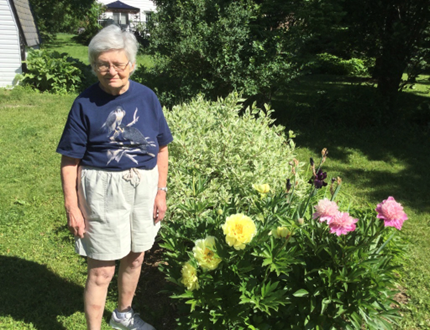
Myrna Wood by her Garden (Photo: Sandra Dowds)
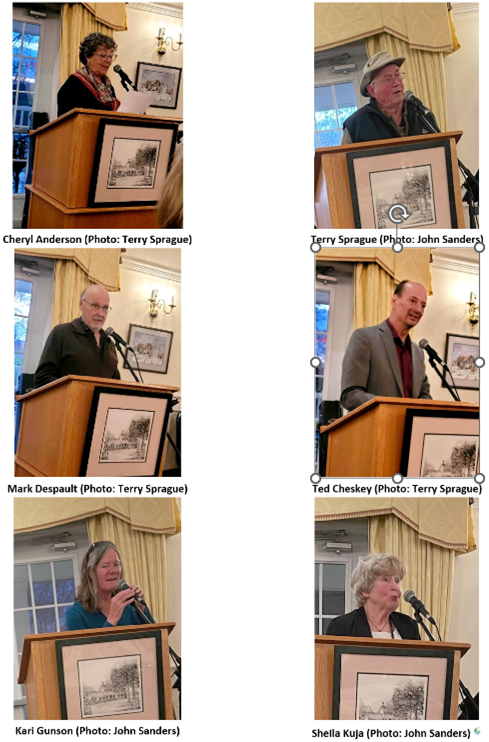
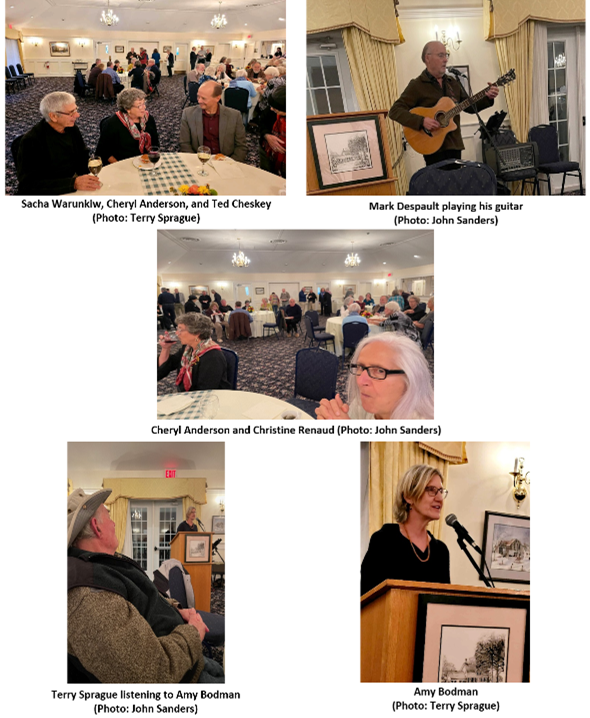
Friends and colleagues of Myrna Wood gathered on November 3, 2025 to celebrate her long and impactful life. Waring Hall was decorated with flowers and a display of Myrna’s meaningful writings and handiwork. Several people spoke, each one with reminiscences of their unique relationship with Myrna – from her time as a leader of the second wave feminist movement to her transition into an environmental activist. Amy Bodman and John Sanders prepared a slide show of photos and memories of Myrna and her family. Mark Despault performed a musical tribute ending with a poignant rendition of the Beatles favourite Let It Be.
While Myrna has left us, her memory will be celebrated. Several memorial tributes are in the planning stages. Stay tuned to hear more about those plans in the next months.
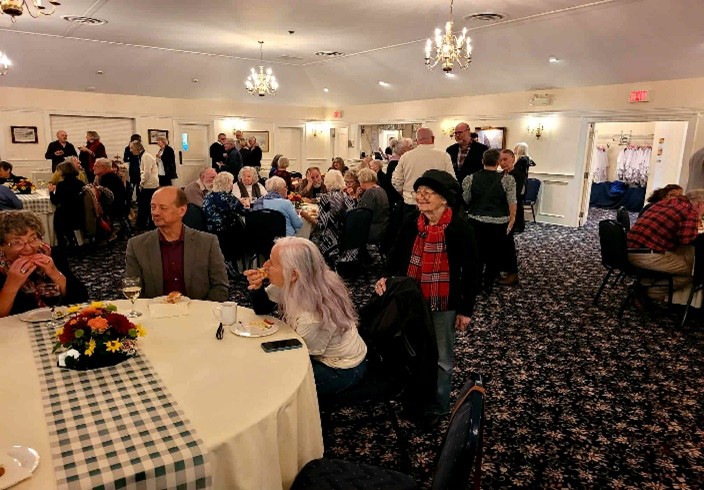
Myrna’s Family and Friends at Waring Hall (Photo: Terry Sprague)

Mark Despault playing Beatle’s song “Let It Be” (Photo: Christine Renaud)

Editor's Note
This is the 33rd edition of The South Shoreliner. The editor would like to thank the following for contributing to this 33rd edition of The South Shoreliner: Cheryl Anderson, Oliver Herford, Clement Kent, Christina Rossetti, Steve Burr, John F. Foster, J.C. Sulzenko, and Cheryl Chapman. Contributions make the newsletter readable and interesting. For the next and upcoming newsletters, contributions of articles, photos and events are always welcome.
-- John F. Foster, The South Shoreliner Editor
Follow us Facebook
Connect on Instagram
1-613-849-7743 | [email protected]

Do you like this page?