
📝 Steven Burr
The Moon
The Full Harvest Moon arrives on 7th of October. In accordance with the Farmer’s Almanac, the harvest moon is the nearest full moon to the fall equinox and is so named for providing farmers with several extra evenings of moonlight to finish harvesting their crops. On the evening of October 9th, the waning gibbous moon passes in front of the Star cluster Pleiades. The last quarter moon falls on the 13th with the moon passing within 2° of M44 Beehive Cluster in the constellation of Cancer early in the morning hours of the 15th. On the 21st, the new moon arrives giving us an excellent time to observe the Milky Way Galaxy as it arches overhead from the northeast to the southwest. The first quarter moon makes its appearance on the 29th.
The Planets
Venus remains bright in the morning twilight. On the 19th, Venus passes within 4° of the waning crescent moon just prior to sunrise. Mars is now becoming difficult to locate in the evening twilight as its elongation to the sun diminishes. Jupiter is now rising close to midnight and will become a prominent evening object as the month progresses. For those with telescopes, Jupiter will have a number of double shadows cross its surface on the following dates: 6th, 11th, 14th, 18th, 20th, 22nd, 25th and 29th. For further info, please refer to RASC Observers Handbook 2025. Saturn is now well placed in the evening sky for observing. However, its tilt from our perspective continues to reduce and thus we view the rings more edge on.
Zodiacal Light
Once again starting around the 19th of the month, Zodiacal light will be visible for two weeks in the east just prior to the morning twilight. It will appear to be a cone of light above the Eastern horizon originating from sunlight reflecting off dust grains that orbit the sun in the inner solar system.
Draconids & Orionids Meteor Showers
This month we have two meteor showers to choose from, the Draconids and the Orionids. The Draconids meteor shower peaks on the 8th/9th of October with up to 5 meteors per hour. This meteor shower originates from dust debris left by comet 21P/Giacobini-Zinner which takes 6.6 years to orbit the sun. Look to the constellation of Draco to find where the meteors will radiate from. The Orionids meteor shower peaks on the 20th/21st of October with up to 20 meteors per hour. Dust and debris from Halley’s Comet are the origins of this meteor shower. Luckily this year, we have a new moon so there will be no moonlight to interfere with viewing. The radiating point for this meteor shower is the constellation of Orion. You will find this constellation low on the eastern horizon prior to midnight.
Constellation Pisces
Pisces is Latin for Fishes and is located just south of Pegasus in the night sky as part of the zodiac. According to Greek mythology, Aphrodite and her son Eros were visiting Syria by the river Euphrates when all of a sudden Typhon appeared, startled Aphrodite and Eros hurled themselves in the river where they turned themselves into fish to escape. It is thought this event was commemorated by placing the fishes in the night sky. The Babylonians also named this constellation the Fish prior to the Greeks incorporating it into their star lore. The Messier 74 spiral galaxy is located in the constellation of Pisces.
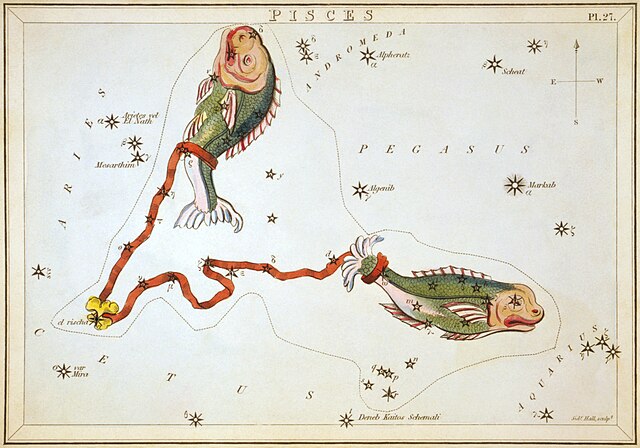
Pisces; Urania's Mirror 1825
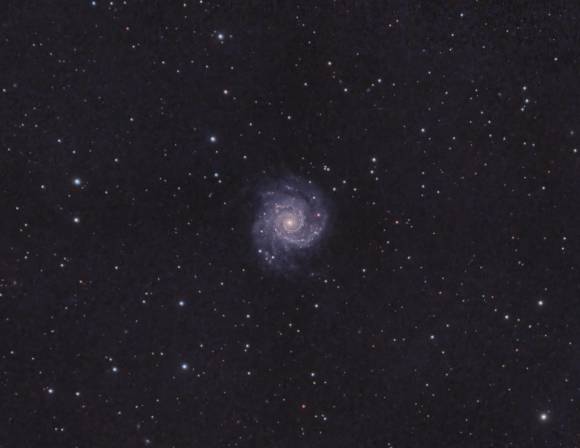
M 74 - Robert Bates
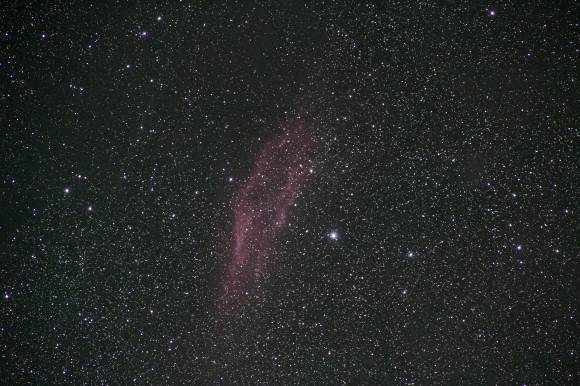
California Nebula - David Cotterell
Make sure to follow our events page for all upcoming Astro Talks here.
References (for October and September Blog):
Boeckmann, Catherine, Full Moon Names 2025 [online]. Almanac, updated January 2025 [cited 3 January 2025]. Available from: https://www.almanac.com/full-moon-names
Burnham, Robert, Burnham’s Celestial Handbook Vol 3 (New York: Dover Publications, 1978)
Draconids Meteor Shower 2025 [online], Timeanddate, [cited 24 January 2025]. Available online from: https://www.timeanddate.com/astronomy/meteor-shower/draconid.html
Edgar, James S. ed., RASC Observer’s Handbook 2025, ed. by James S. Edgar (Marquis Book Printing, 2024)
Hard, Robin, Eratosthenes & Hyginus: Constellation Myths (Oxford: Oxford University Press, 2015)
Leonids Meteor Shower 2025 [online], Timeanddate, [cited 24 January 2025]. Available from: https://www.timeanddate.com/astronomy/meteor-shower/leonids.html
Mortillaro, Nicole, RASC 2025 Night Sky Almanac (Richmond Hill: Firefly Books, 2024)
Orionids Meteor Shower 2025 [online], Timeanddate, [cited 24 January 2025]. Available online from: https://www.timeanddate.com/astronomy/meteor-shower/orionid.html
White, Gavin, Babylonian Star-Lore: An Illustrated Guide to the Star-Lore & Constellations of Ancient Babylonia (London: Solaria Publications, 2014)
Do you like this page?
